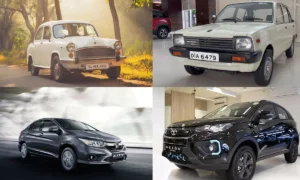
Owning a car is an emotion. A car not just provides convenience but works for one at a psychological level. In this article, we explore the journey of automobiles in India: the Indian automobile industry.
You’ll be surprised to note that 78 years have passed since India earned her independence. The auto industry, too, on the same lines, has transformed with each passing decade.
In the days of yore following Indian independence, there never used to be too many cars on the road. However, stories of congestion and traffic jams are now at least three decades old.
So, what all has transpired in the automobile industry since India’s independence? Let’s read on to find out more. We have divided this article into multiple sections for the convenience of readers. Each section discusses a unique phase in the journey of the Indian automobile industry.
The Initial Years: 1945-1970
It is noteworthy that following India’s independence, the growth rate of the Indian automobile industry was slow. This can be attributed to the strict policies that used to be in existence.
The most important players during those days used to be Premier Automobiles and Hindustan Motors. It goes without saying that only the upper class used to, then, be in a position to afford cars.
The government had placed strict restrictions on the automobile industry to discourage foreign players. This was to encourage the local industries and businesses.
With limited competition in the industry, innovation stood at grassroots levels.
Maruti Udyog pioneers a new era in the Indian automobile industry: 1981
A fact that many readers might not know about Maruti Udyog Ltd. (MUL) is that it is an Indian government company. It was back in February 1981 when a collaboration took place between Suzuki Motor Corporation and MUL. The two prominent market players, at this point, wanted to manufacture a car that easily came in the budget range of middle-class households in India. Interestingly, it was Sanjay Gandhi, Prime Minister Indira Gandhi’s son, who had pioneered this venture.
Sanjay Gandhi had a passion for cars. When he returned to India, manufacturing a people’s car was his passion.
Next, in 1970, the government issued a letter of intent that permitted Sanjay Gandhi to produce 50,000 cars each year.
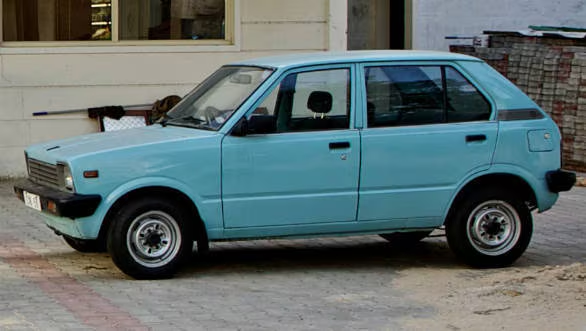
It was in 1984 that the first Maruti 800 was put on the road.
The impact of liberalization (1980s-90s)
Come the 1980s, and the Indian government adhered to the policies of liberalization and economic reforms. Doors were opened for new technologies and foreign investments. Correspondingly, international carmakers were now permitted to enter the markets. With the newfound competitive spirit, production and quality both enhanced.
The broad branding policy of 1985
It was as late as 1985 that the GoI put forth a ‘broad-branding’ policy into the picture. Auto manufacturers now held licenses to produce a diverse product range. They could manufacture not just passenger cars but also commercial vehicles.
With the economic liberalization of 1991, foreign manufacturers could now invest in India. It was then a matter of time before Toyota and Suzuki, which are Japanese companies, and Hyundai, a South Korean company, began manufacturing light vehicles in India.
Following 1991, the Indian consumer had more choices than he had ever experienced before.
The delicensing policy of 1993 is a point not to be missed here. This delicensing policy is largely seen as the end of License Raj—a phase wherein excessive licensing and rules used to be the order of the day. International players, now, were more than happy to mark their entry into the Indian automobile industry. Besides, the existing firms now had an opportunity to build partnerships with foreign firms.
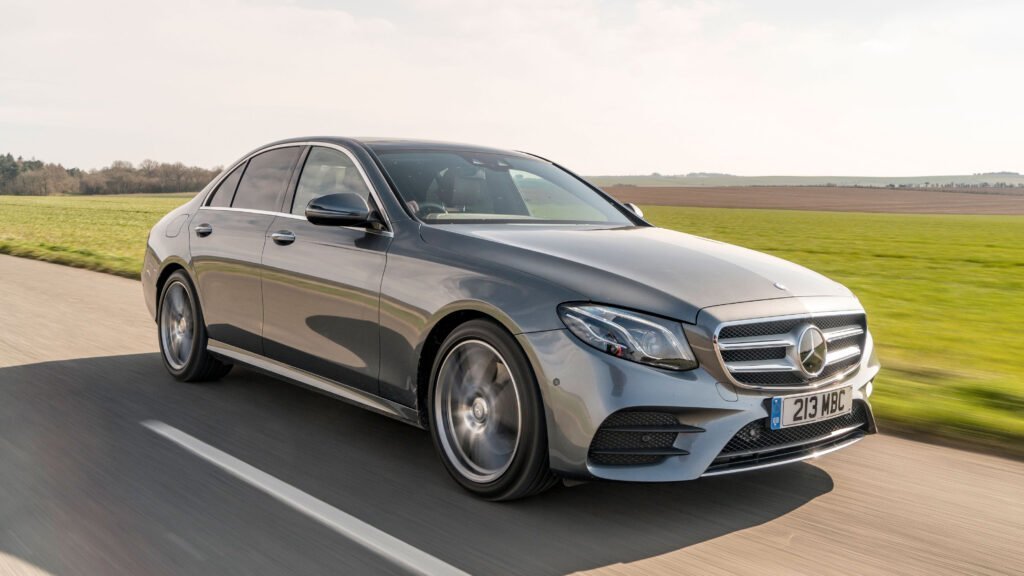
When the Mercedes-Benz E220 hit the roads in 1995, it was the result of a joint venture between Mercedes-Benz and Tata. However, by 2000-01, Tata had sold its entire stake in Mercedes-Benz.
Another interesting fact not to miss was that the Tata Sierra, first launched in 1991, was India’s first SUV (Sports utility vehicle).
Lifting of Import Restrictions in 2001
There used to be a time when quantitative restrictions were placed on vehicle imports. But the GoI lifted these restrictions in 2001. Correspondingly, companies were now permitted to import and sell vehicles built abroad in India.
Export obligations also needed to be met for a year, but these too were lifted in 2002, and this simplified global movement for the vehicles.
Construction of the Mumbai-Pune Expressway in 2002
One of the most important infrastructural landmarks in India’s road construction was the Mumbai-Pune expressway, constructed in 2002. This was a closed-access highway that ran from the source to the destination.
Changes in Environmental Policies and Engine Preferences (1990s to 2020s)
As of the late 1990s, CNG found newfound popularity, and Delhi was the first among initial adopters. It was put to use for public transportation.
The next noteworthy development here is the 1999 order of the Supreme Court of India, which mandated an upgrade of emission control systems. Cleaner and more efficient technologies became a part of the Indian automotive industry. Carburetor technologies saw their final days, and fuel injection systems were widely adopted.
Before these days, diesel engines commanded half the market. This changed because the cost of diesel vehicles skyrocketed. The pricing associated with creating emission-controlled diesel vehicles was much higher. Another important development to be mentioned here is the shift towards hybrid technologies and CNG cars.
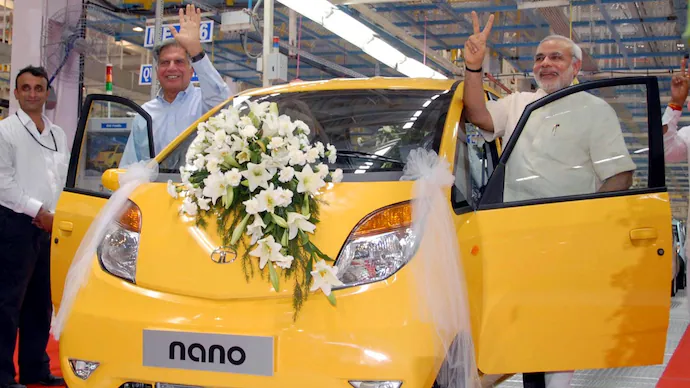
In 2008, Tata Nano was launched for the Indian markets as the world’s smallest car.
India also implemented global crash test standards with the help of NCAP in 2017. Advanced safety technologies hence came to the fore, such as anti-lock braking systems and airbags.
2020 saw the adoption of BS-VI emission standards. The new market environment saw General Motors and Ford bowing out from Indian markets in 2017 and 2021, respectively. This was before Nissan chose to shut down its Datsun brand owing to low sales in 2022.
The 2020s are cited to come by as the green revolution for the Indian automobile industry as the focus shifts towards electric vehicles, which find full support of the Government of India. This is the newest development in the Indian automobile industry. The Minister for Road Transport & Highways, Nitin Gadkari, has declared the paving of 30,000 kilometers of new highways by 2030. The evolution of Indian automobile industry has indeed been a fascinating journey!